Home

OLX — Ad Package

Marketplace · Pay & Ship

OLX is a leading marketplace ecosystem — monetisation at scale across 17 countries.

OLX serves more than 317 million C2C and B2C users buying and selling new and used products globally.

Our users across 17 countries don't just find good deals — they help the environment too, leaning on a circular consumption cycle rather than a linear one.

5.2M
Tonnes of CO₂-eq emissions avoided
3.6M
Tonnes of materials reused
645M
M³ of water saved
122M
GJ-eq of energy saved
Aerial view of a forest with a lake shaped like the OLX logo

My role

My role

I led Engagement & Monetisation design in Pay & Ship — payments, seller monetisation, and checkout across 17 countries on a platform used by 317M+ people.

I was responsible for all things design within the Engagement & Monetisation packs, under the Pay & Ship pillar. That scope covered monetisation flows end to end — Ad Limits, Ad packages, Seller Take Rate, and the payment gateway experience — then rolling winning patterns to more of the 17-country footprint.

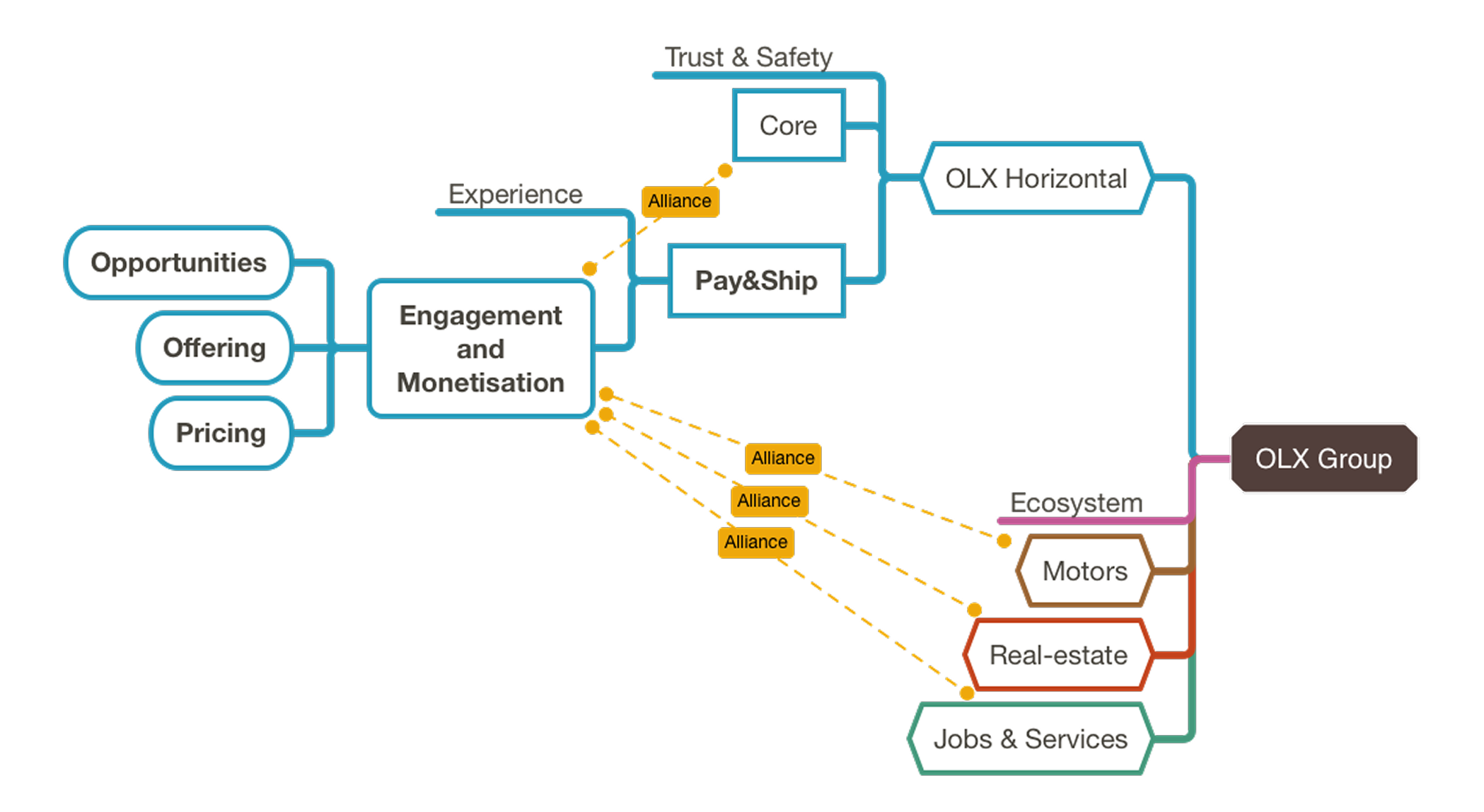
Org map: Opportunities, Offering and Pricing feed Engagement & Monetisation, which sits under Pay & Ship inside OLX Horizontal and the wider OLX Group

Case study · OLX Group

OLX Ad Package

16 weeks of design timeline · In development

OLX is monetised through Ad Limits, and one of the primary ways Sellers keep posting more ads is by buying Ad packages.

The updated Ad-package purchasing UX streamlines category selection and provides clearer guidance when buying Ad packages.

Impact: +12% conversion uplift trend, 8% more paying Sellers, CSAT 7.9 — validated in Poland and rolling out across markets.

Shoutouts

Lorena (UX Writer), Małgorzata (Researcher), Claude (PM), Oana (CPO), Kuba (EM), Monica & Arsen (Jr. PD) — along with the Engineering & BI teams.

01
Monetisation Pay & Ship

Business objective

Grow the share of monthly paying Sellers through improvements to existing monetisation flows — while contributing to a CSAT goal of +8.0.

Even a 1% increase in paying Sellers can amount to an additional $110k–$160k in monthly revenue.

Customer Satisfaction

Baseline CSAT the redesign aims to lift toward +8.0.

Build a profitable transactional business ensuring high retention and improving CSAT

Background

Understanding the domain

As a Seller on OLX you get a few free ads until you're required to pay — with the option to promote Ads to potential Buyers on a 30-day Ad life-cycle. Sellers create ads, hit the paywall and promotion, run a 30-day lifecycle via the Marketplace, then OLX Delivery to Buyers.
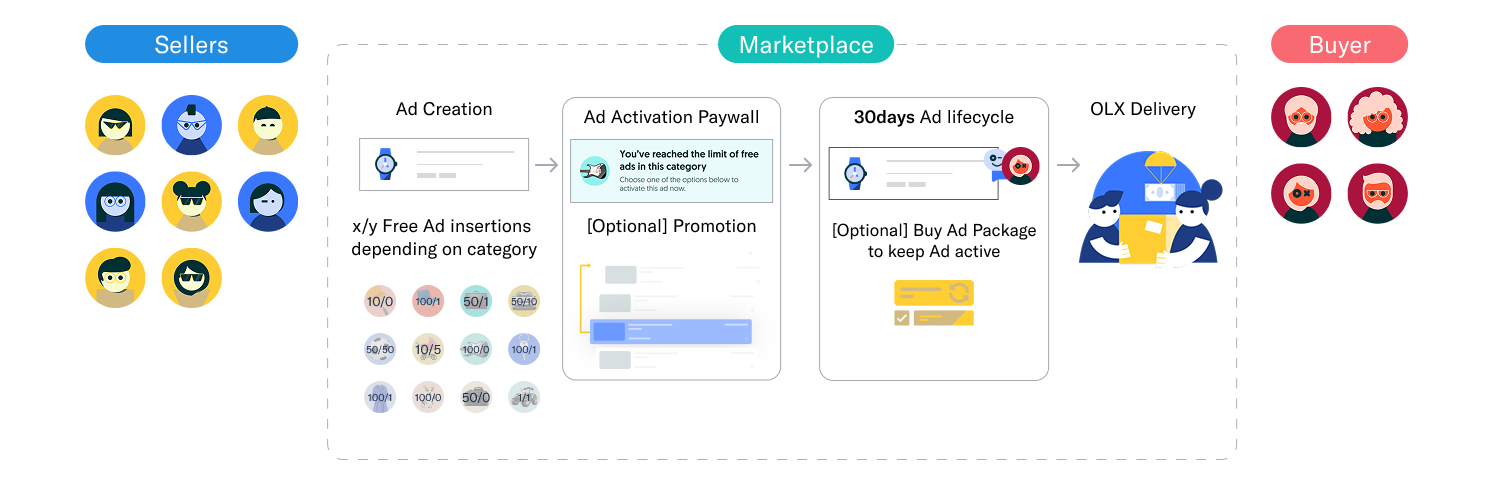
OLX monetisation ecosystem — Sellers create ads, hit the paywall and promotion, run a 30-day lifecycle via the Marketplace, then OLX Delivery to Buyers

Personas

Seller & Buyer types on OLX

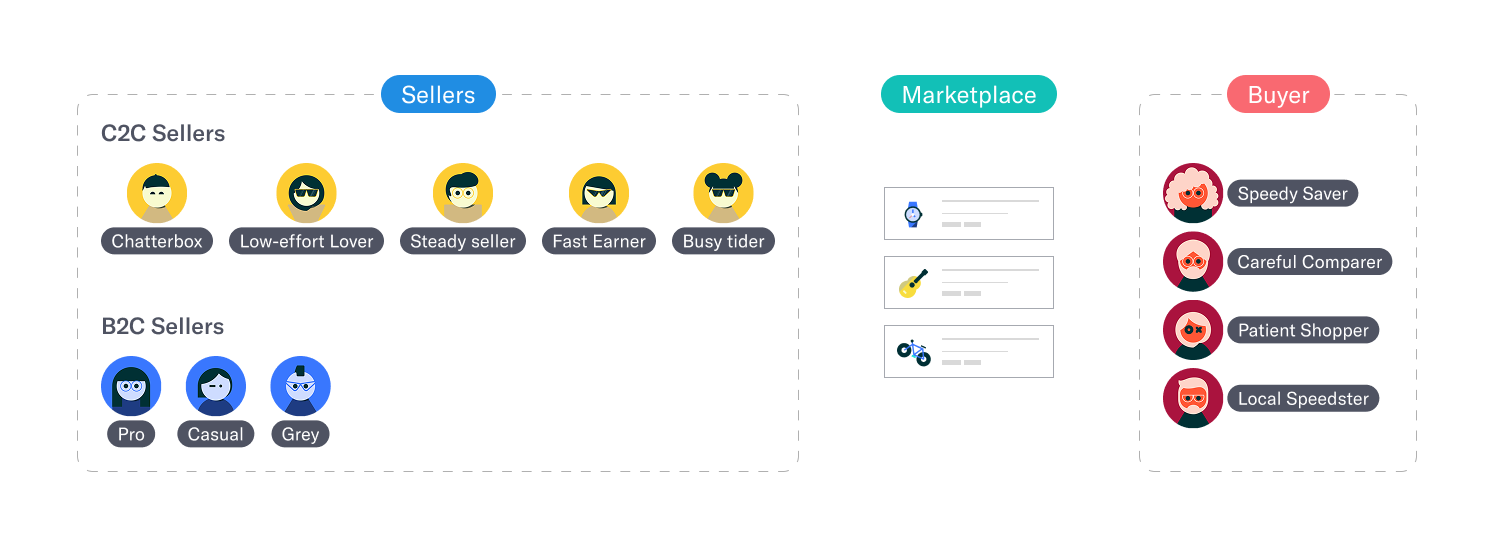
C2C Sellers (Chatterbox, Low-effort Lover, Steady Seller, Fast Earner, Busy Trader), B2C Sellers (Pro, Casual, Grey) and Buyer types (Speedy Saver, Careful Comparer, Patient Shopper, Local Speedster) — the monetisation flows serve both sides of the marketplace.

Seller and Buyer personas — C2C Sellers, B2C Sellers and Buyer types
02
ResearchOpScore

Research through prioritisation

12 Seller interviews, 24 limitations, and Opportunity Scoring — category selection emerged as the bet at OpScore 13.12.

Jobs to be Done

Initiate research — Jobs to be Done

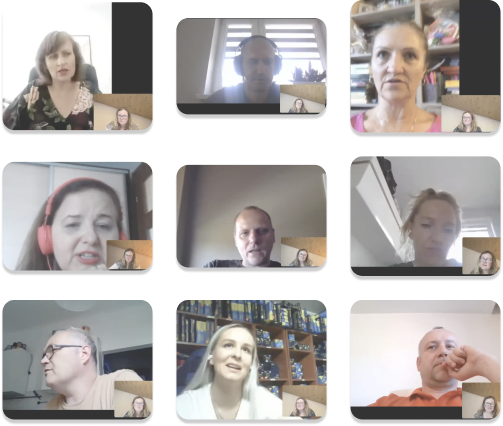
To begin, we ran 12 B2C & C2C Seller interviews to understand their Desires, Limitations and Catalysts when selling on OLX — with emphasis on the monetisation flows.

When

Sellers (B2C/C2C) choose OLX to sell one or multiple goods and list their Ads.

User

They would like to

Determine & act on how to attract Buyers to their goods.
Optimise the pricing of under-performing goods against the money they invest.

Job step

So that

B2C/C2C — they reach their desired ROI per item.
C2C — they feel they're contributing to sustainability and getting rid of unwanted goods.

Catalysts

Grid of 12 remote interview participants across B2C and C2C Sellers
12 remote interviews across B2C and C2C Sellers.

Synthesis

We analysed the 24 identified limitations

Post qualitative research, findings were clustered into 24 limitations. With: Research Lead, Lead PM, HOD, myself & 2 Jr. Designers.

Sellers can't relate to what personalisation does to their AdsThe personalised-page option wasn't transparent or attractive enough to users.
Statistics feel like a free feature — why pay for it?Sellers assume Ad statistics are always free, so the benefit of paying is unclear.
No freedom to decide when to use Pay-if-you-sellYou first have to use up the pool of free ads to use STR — and Sellers often don't know this.
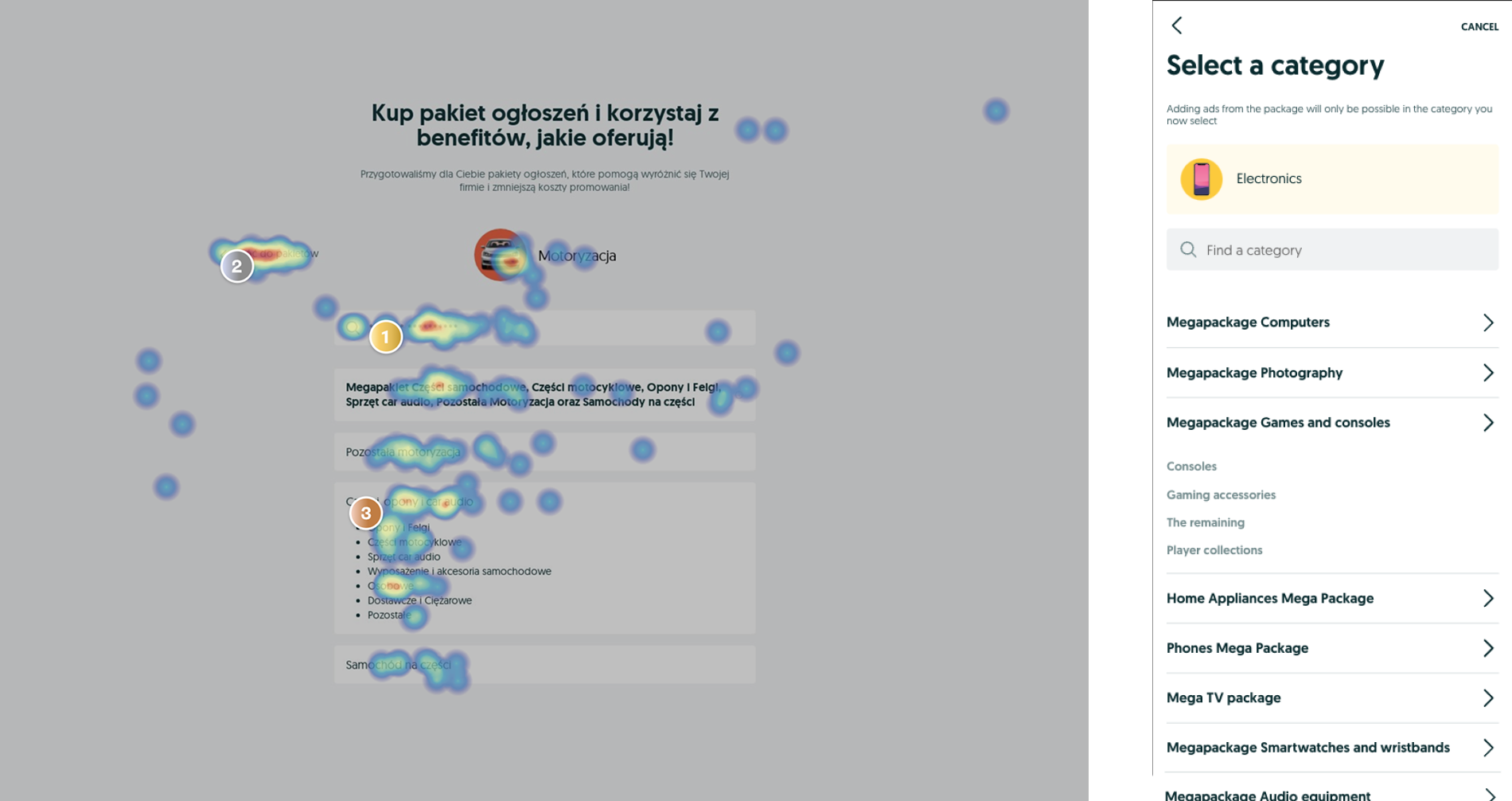
Hard to find the exact category when buying Ad packagesSellers don't find the category-selection process user-friendly. OpScore 13.12 — the bet.
Sellers don't see the direct results of paying for promotionsPromotion lifts views, but that didn't clearly translate into sales versus re-posting.
Package price is often inadequate to item priceFor cheap items the package price is close to the item's value — the sale is no longer profitable.
STR is only available for OLX Delivery listingsUsers may not know STR exists, especially if their inventory doesn't match OLX Delivery.
…and 17 moreAll 24 limitations were mapped, then quantified and scored next.

Prioritisation

Quantification to prioritisation

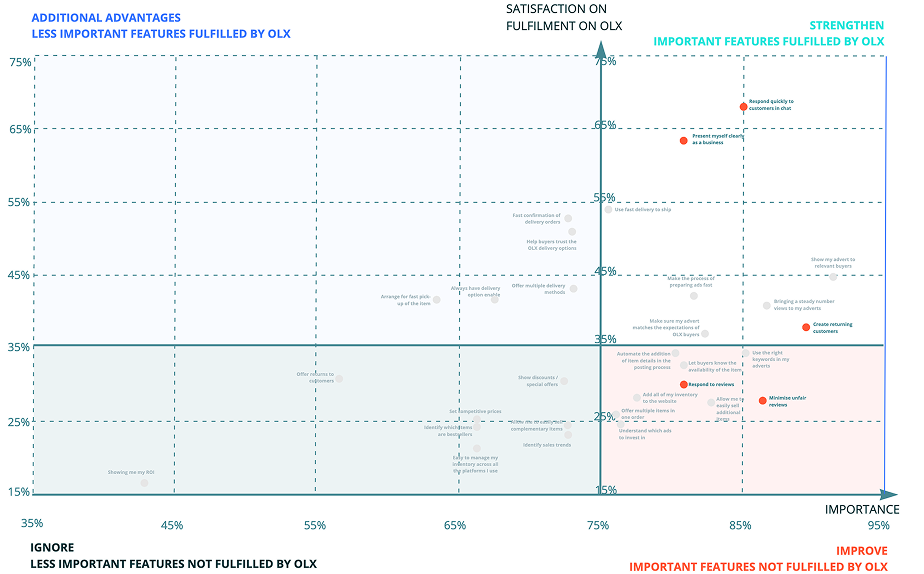
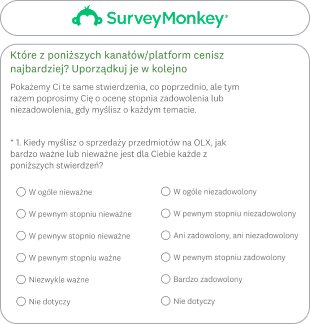
I surveyed Sellers on the importance & satisfaction of each problem area, then used Opportunity Scoring to generate an OpScore. Category selection was a top opportunity — the bet we chose.

OpScore = Importance + max(Importance − Satisfaction, 0)
Opportunity landscape plotting each feature by importance against satisfaction
Opportunity landscape — category selection was a top opportunity (OpScore 13.12).
SurveyMonkey questionnaire asking Sellers to rate importance and satisfaction for each problem area
03
Drop-offUX audit

Identified problem

“I like the option to buy an Ad package in advance, but it gets tricky to find the same category in which I post multiple ads.”
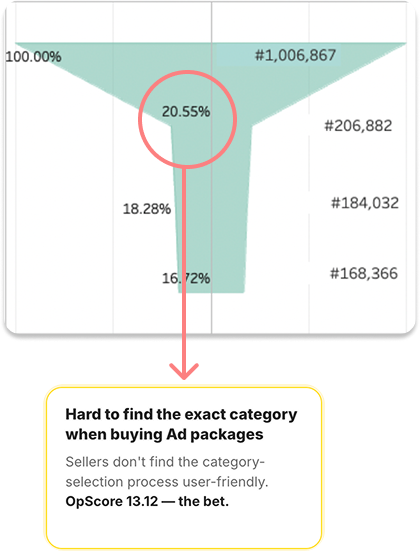
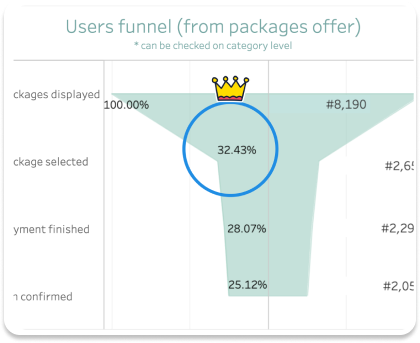
Users funnel from the buy-package flow: 20.55% at package selected, with category-selection called out at OpScore 13.12

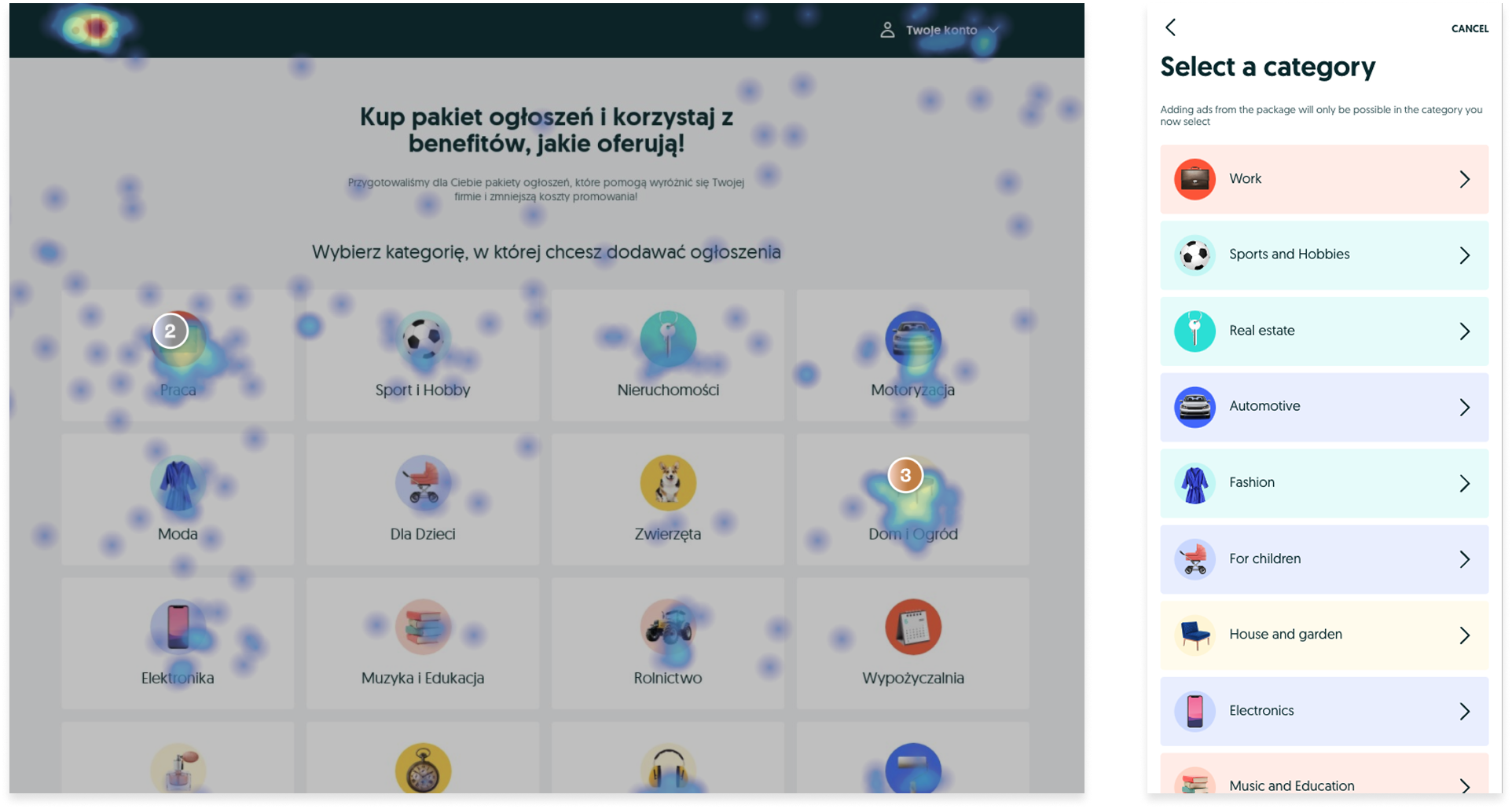
Almost 80% of B2C and 90% of C2C Sellers drop at the category-selection page of the buy-package flow. Funnel data showed only 20.55% of users reaching package selected — category-selection flagged at OpScore 13.12.

Audit

Ran a UX audit on the buy-package flow

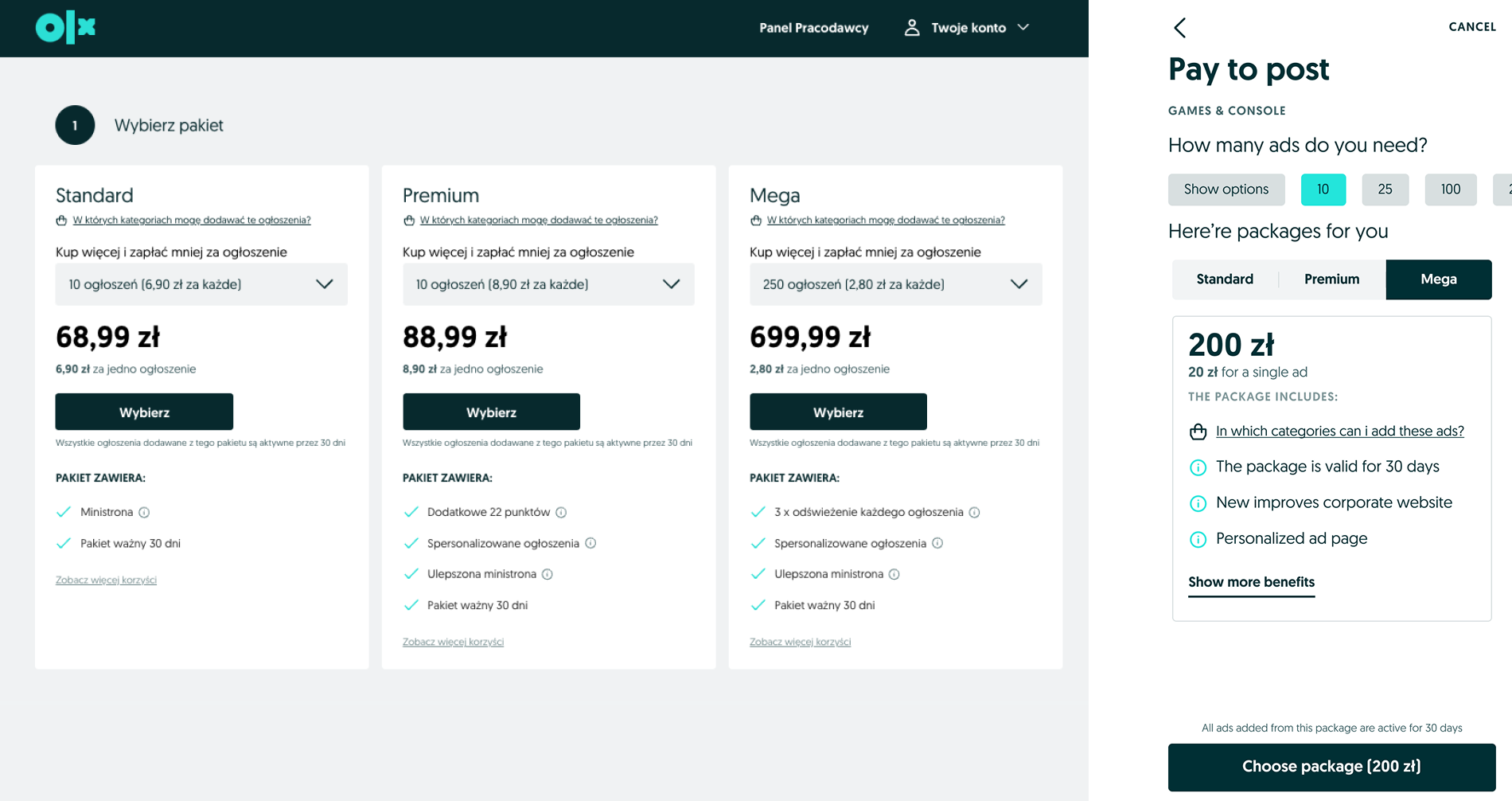
Five findings from Hotjar recordings, heatmaps, and flow walkthroughs — hover a finding to see the screen.

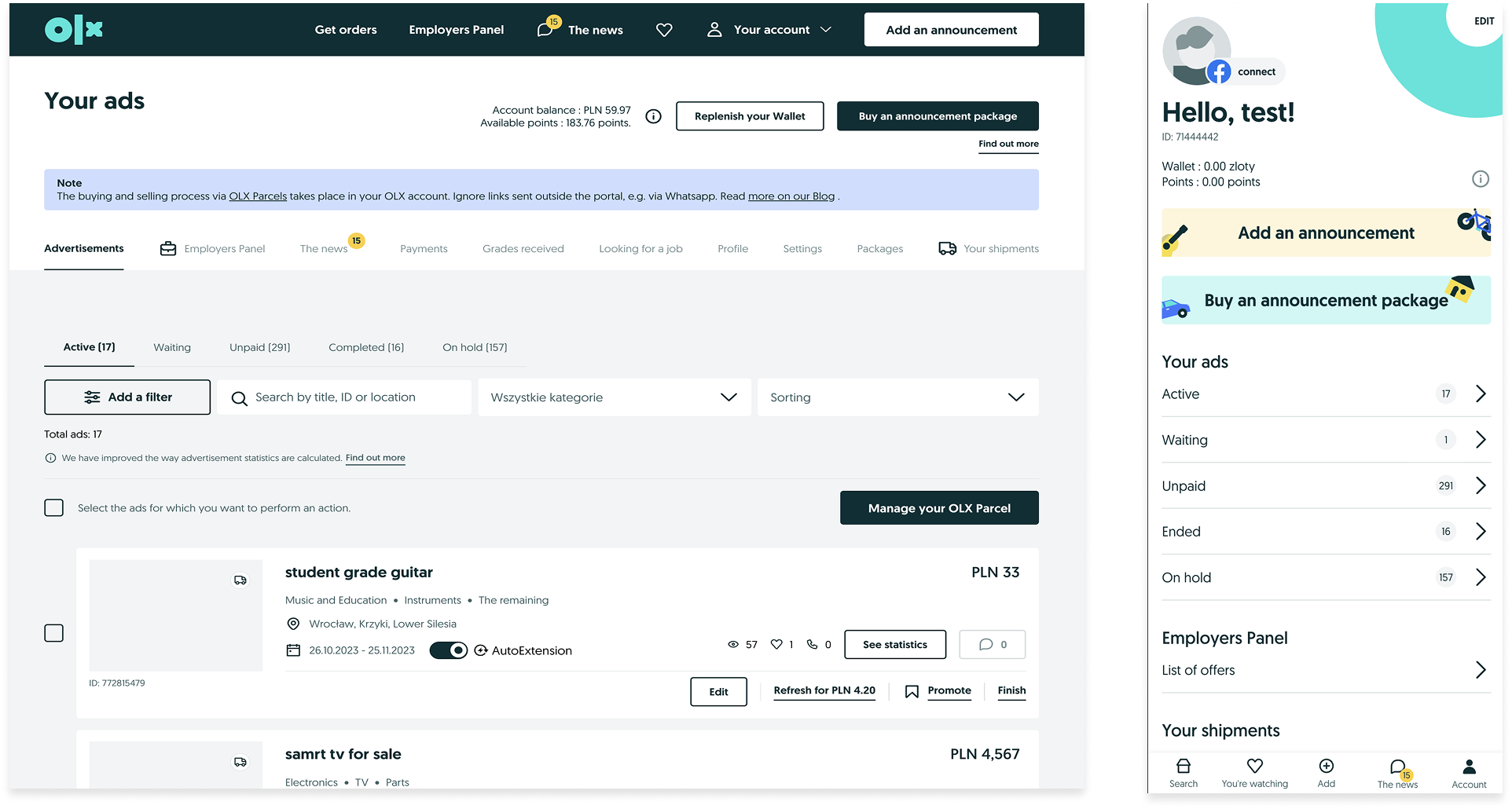
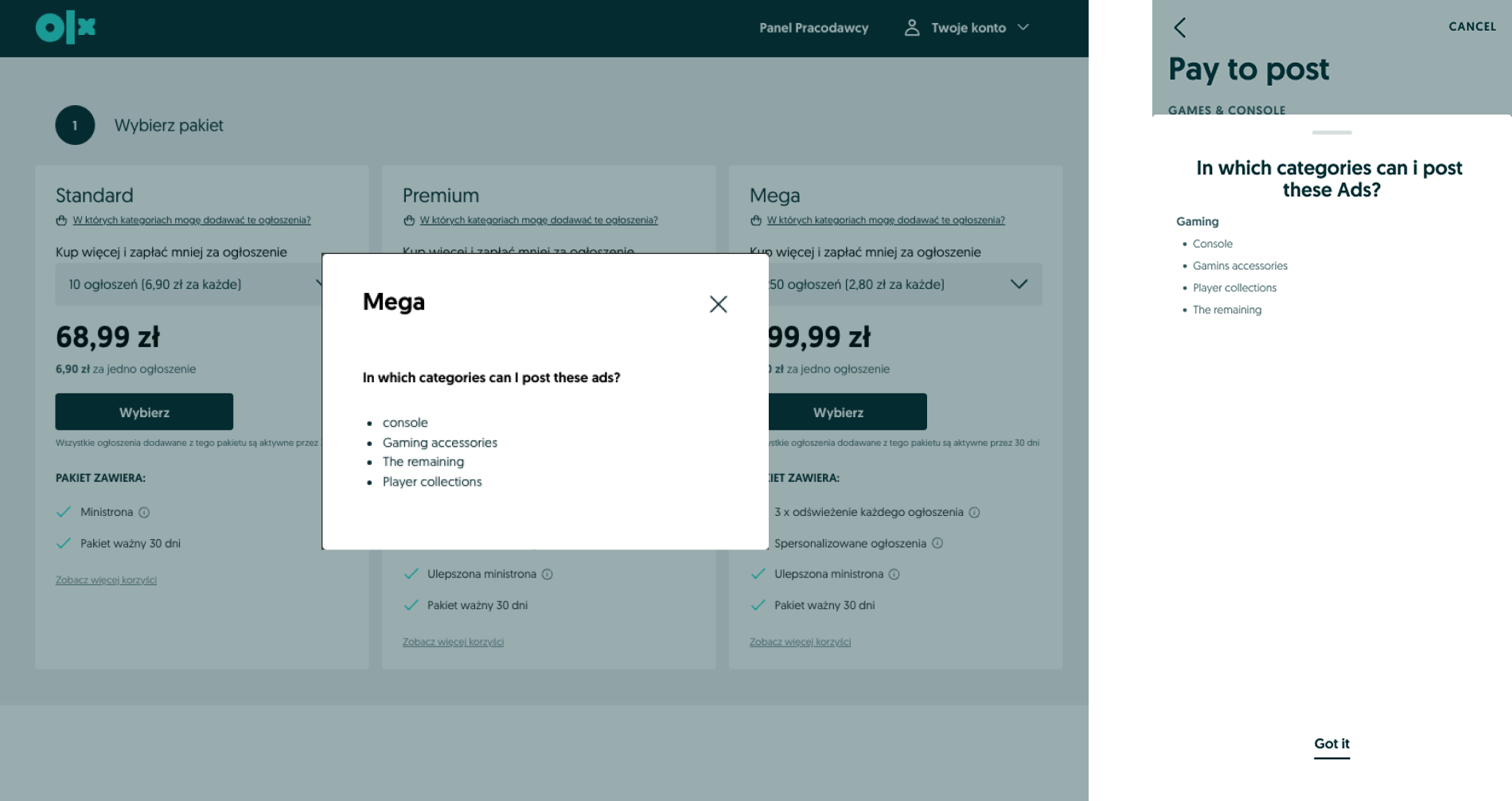
Audit — seller account overview Audit — category grid with click heatmap Audit — long L2 sub-category list Audit — package selection Audit — mega-package details
Hover a finding to see the screen · click to zoom

Explore

Designed 3 possible directions for desktop

Why desktop first? More than 60% of Ad packages are purchased via the OLX website.

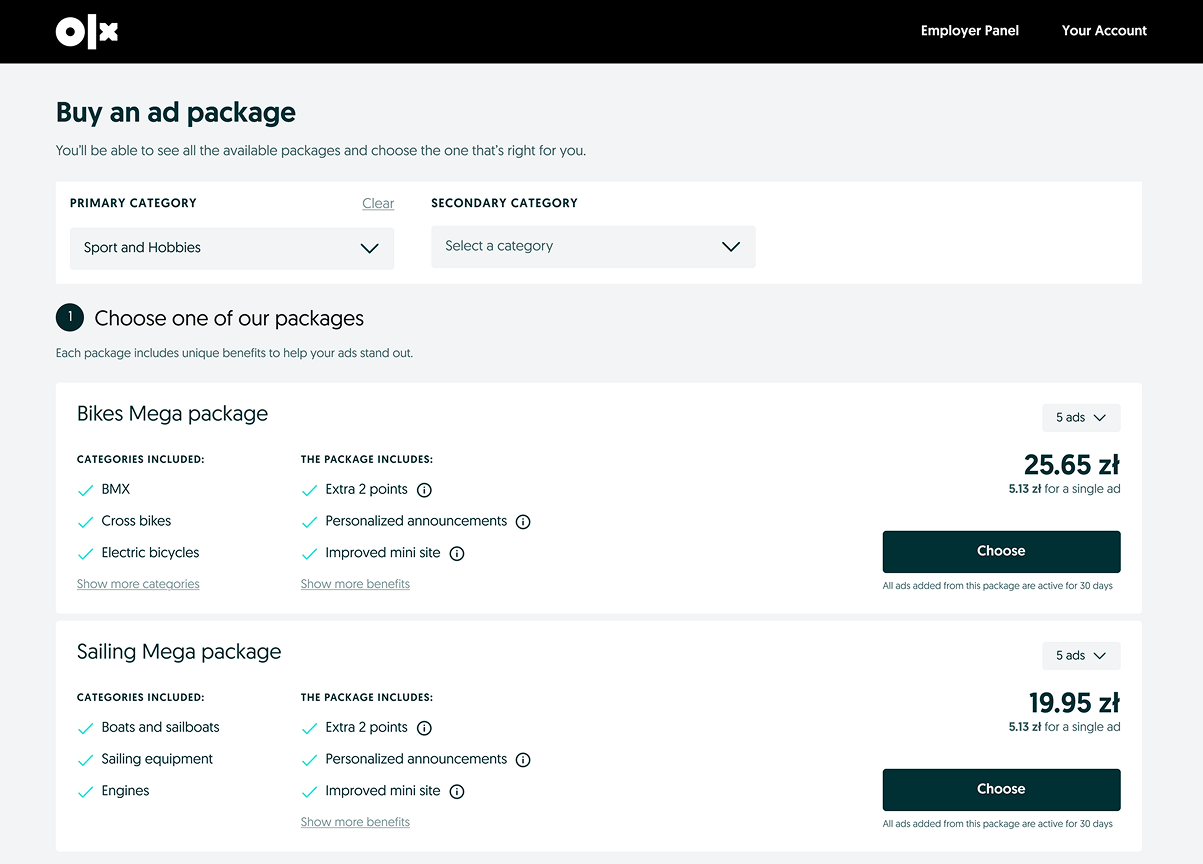
Direction 1 — real-time offer view

#1 Hypothesis

Real-time offer view

Users would appreciate if they can simultaneously browse Ad packages while choosing the category in which they'd like to post ads, making the overall process dynamic.

Offers are shown based on availability. Categories are seen upfront on the offer view.

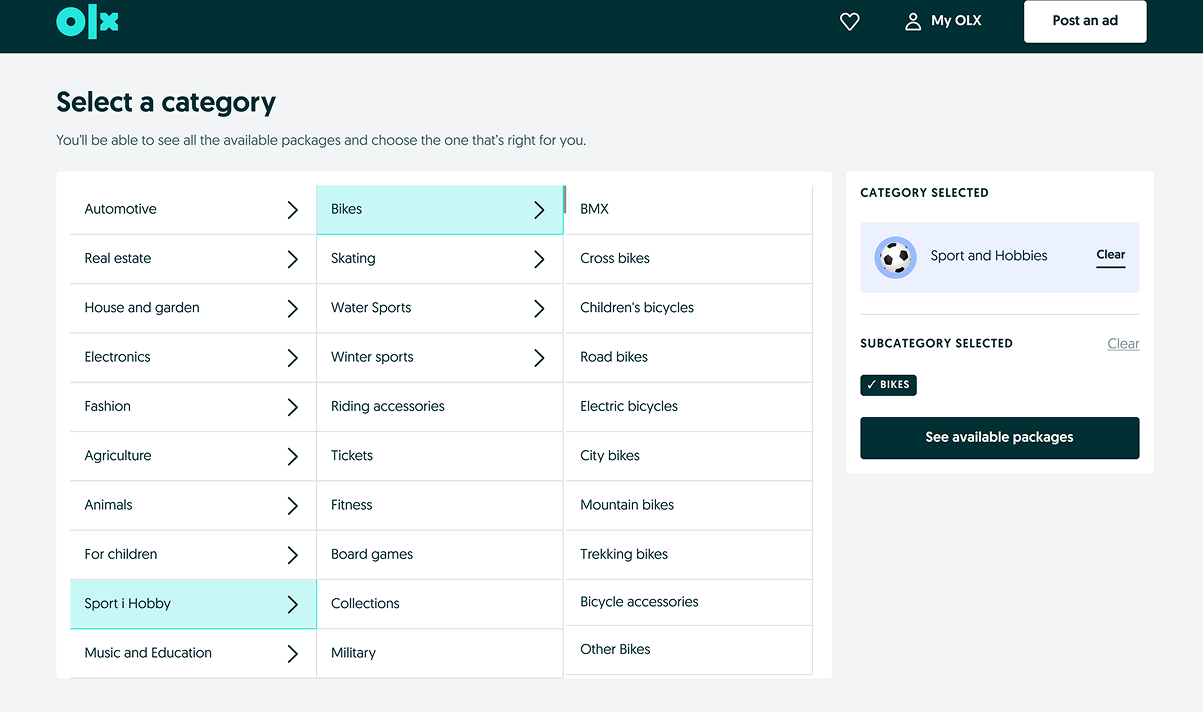
Direction 2 — multi-level category menu

#2 Hypothesis

Multi-level menu

A linear selection process should reduce cognitive load, along with the multi-level menu that should ease the selection process.

Minimum selection to see offers would be L2 selection. Selected category is marked with a '✔' at summary & offer page.

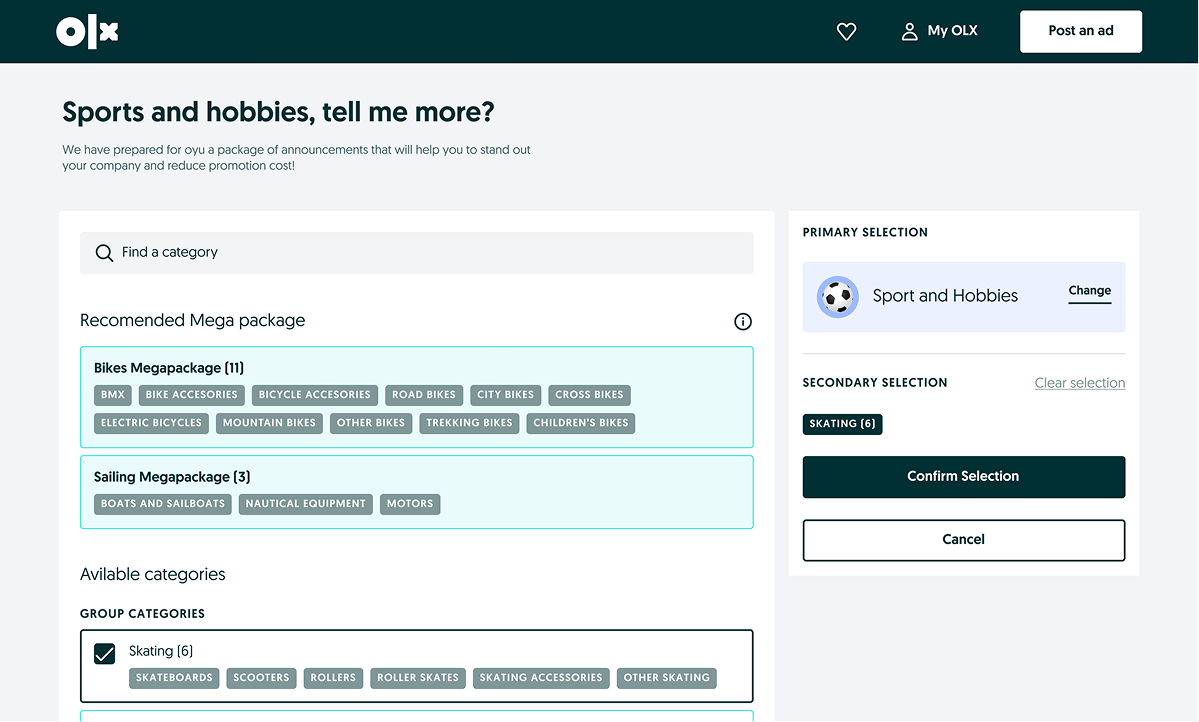
Direction 3 — multi-selection view

#3 Hypothesis

Multi-selection view

OLX only offers packages in pre-set bundled categories; letting users multi-select category bundles could enable advance planning.

Letting users multi-select categories across various L1 would require change in business logic (high effort), and so in the current state only multiple bundles can be selected.

Two concepts

Two directions, head to head

Interactive — tap a prototype to advance

Variant A · Real-time offer view
Frame 1 / 5
Variant B · Multi-level menu
Frame 1 / 5

Design critique to narrow it down to 2 ideas.

9 P&S designers, 4 PMs across pillars, the Engineering team, the P&S HOD and the Data team.

Usability testing

We tested 2 concepts with 10 users

Moderated sessions compared Variant A (real-time offer view) against Variant B (multi-level menu) — each insight paired with the takeaway it drove.

A 4/8 struggled to associate dropdown categories with the dynamic offer. Task time was 15% lower than Production.
Primary/secondary/tertiary categories got associated with filters — adding cognitive load and failing the hypothesis.
B 7/8 were satisfied with the multi-level menu and appreciated the summary view. Task time was 28% higher than Production.
Users found categories with ease; one suggested a shortcut to repeat the selection.
A Only 2/8 found the filter view easier to compare — and they ignored the 'see-more' CTA while comparing packages.
Most users expect offers to carry as much upfront information as possible.
B With upfront category tags, 5/8 intuitively named categories as a variable for why price differs per package.
Users don't always tap see-more — a long list of category tags can also add cognitive load.
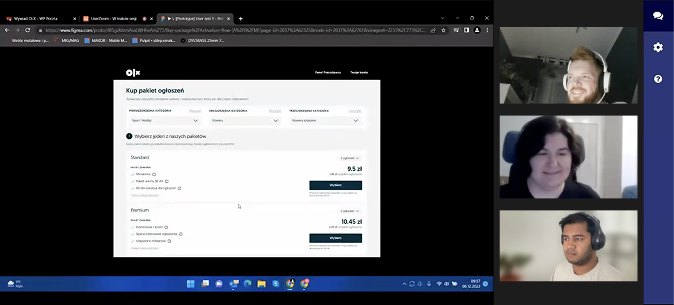
Moderated session — Variant A
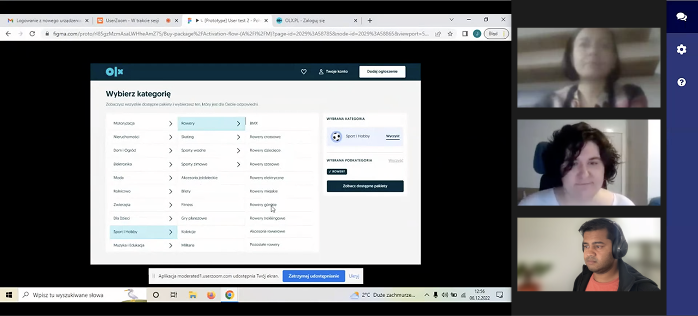
B Moderated session — Variant B, usability test winner

Outcome

Validated on production

Variant B went into an A (Production) / B (Multi-level menu) test in Poland — with uplift rolling out across markets.

+12%

Upward trend in package purchase conversion · Poland A/B

8%

Increase in paying Sellers

7.9

Seller CSAT · +0.6 from baseline 7.3

Rolling out

Winning pattern across markets · mobile aligned

Conversion uplift in the buy-package flow after Variant B — +12% trend
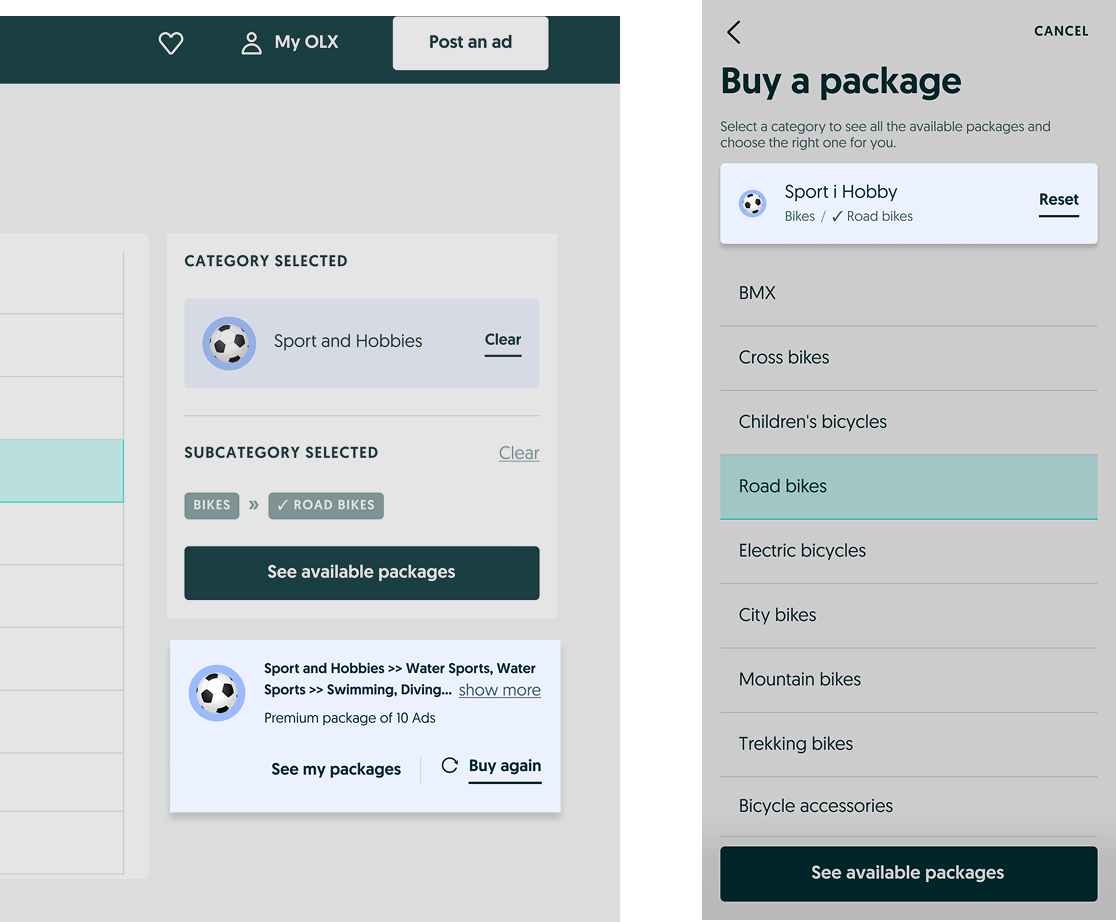
Desktop and mobile buy-package flows — shortcut banner and aligned category selection

After launch

Next steps

A usability participant flagged repeat Ad package purchases — and data showed ~31% of B2C Sellers were buying again. We shipped a shortcut banner for their last package — the first step toward recommendations from Ad posting history.

Package recommendations are in moderation and live in Poland. The winning category-selection pattern is on mobile too.

Highlights

Beyond the case study

Cross-pillar workshops that scaled practice across Pay & Ship and the wider design org.

Design sprint workshop — Pay if you sell auto-extend

Pay if you sell — auto-extend sprint

Lead a cross-pillar design-sprint resulting in auto-extend feature for ‘Pay if you sell’ model.

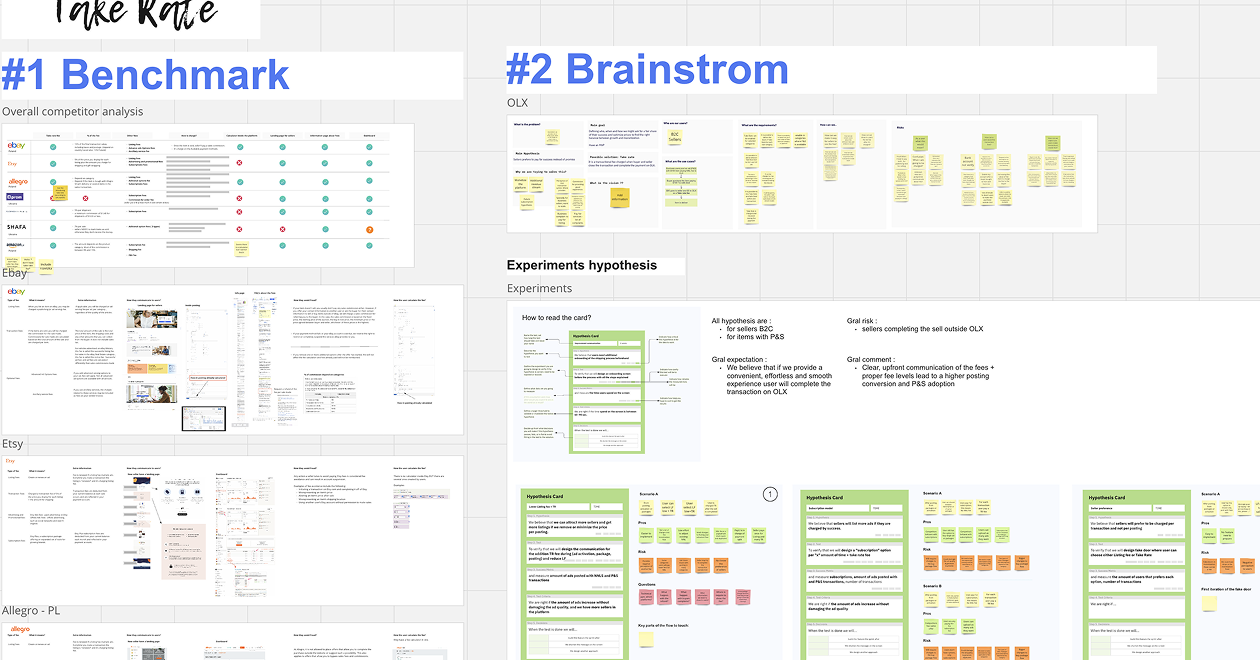
Monetisation packs · Sellers success domain

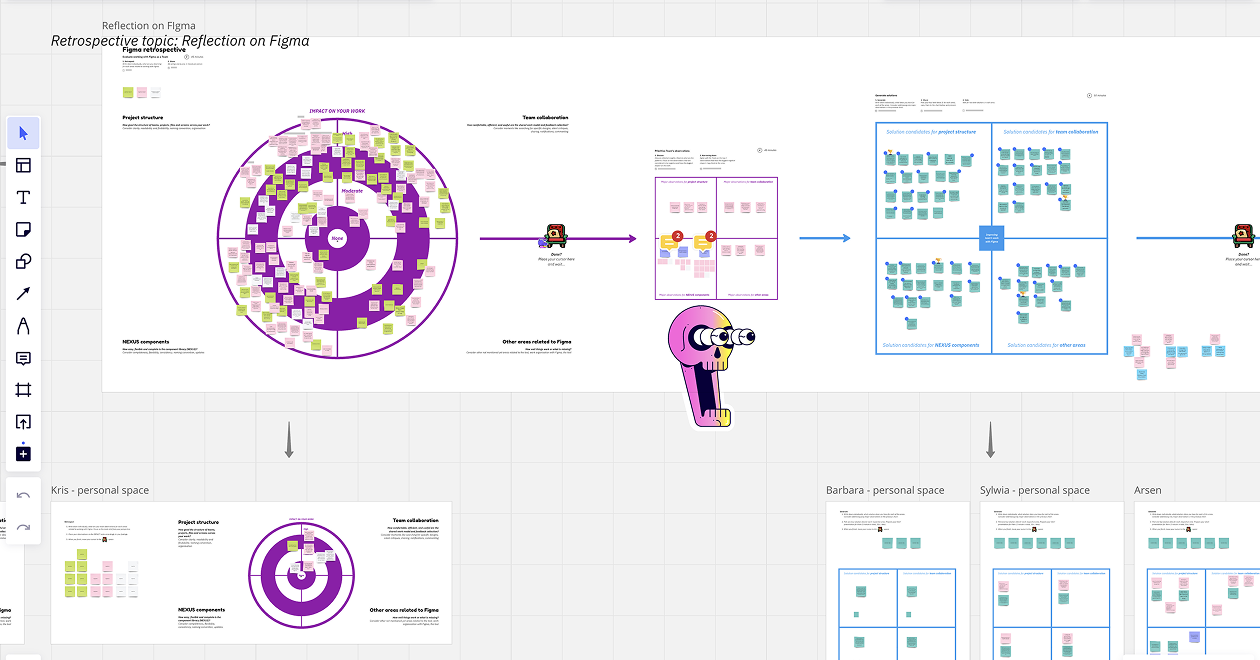
Figma master pages workshop with product designers

Figma master pages alignment

Lead a designer group to align ways of working to create & maintain master pages on Figma.

12 Product designers across Pay&Ship, Engagement and Core

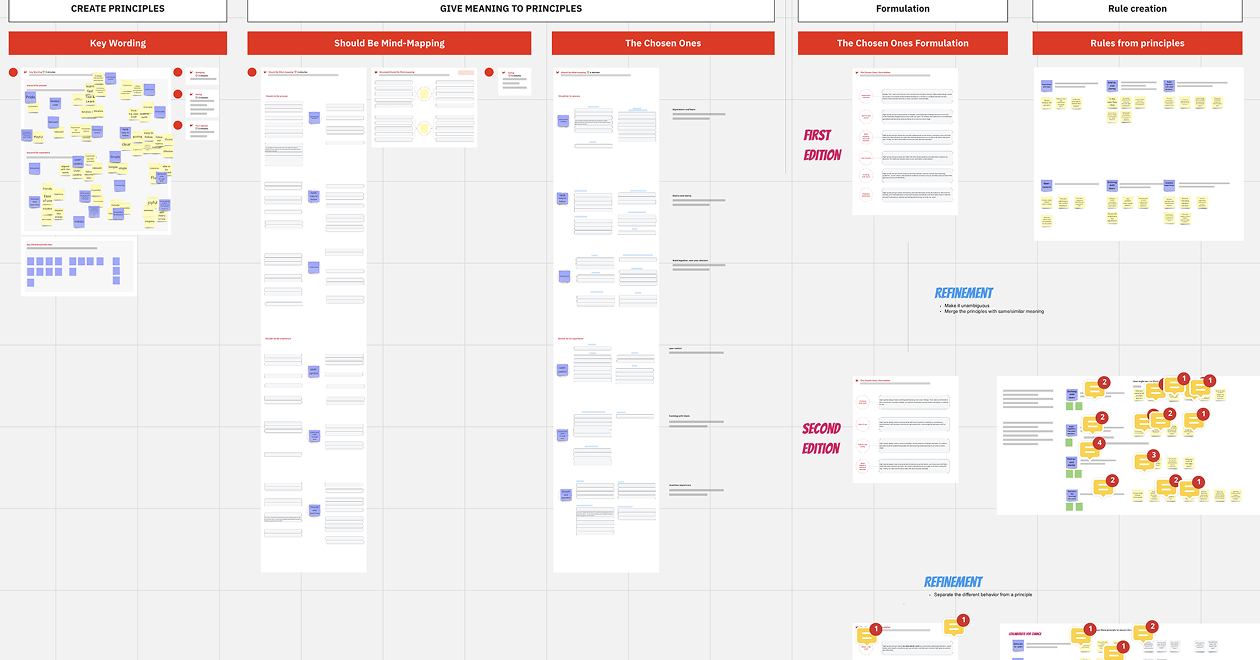
Design principles workshop board

Co-leading OLX design principles

Co-lead design principal workshop with 2 Heads of Design, 4 Design leads and 4 Sr. Product Designers.

Increase confidence through clarity.

At OLX, we prioritize clarity at every level – within our ecosystem and across teams.

Keep it simple

We embrace simplicity as the foundation of our design philosophy.

Harmonious Integration

Each component seamlessly contributes to the overall system.